Document Indexing: From Gold Layer to Knowledge Graph
What actually happens when a document is indexed into IndentiaDB? This interactive visualization follows one real-world example — a Dutch parliamentary document (https://id.indentia.ai/parl/document/00000000-0000-4000-a000-000000000000/tweedekamer/kv-tk-2019z23964) — from the moment its curated gold record arrives, to the triples, relations, embeddings and projections it becomes.
Open the interactive visualization :octicons-link-external-16:
What the visualization covers
- Three explanation levels — a high-level conceptual summary, a translation for readers who know Elasticsearch, and a detailed walkthrough of every phase with component references.
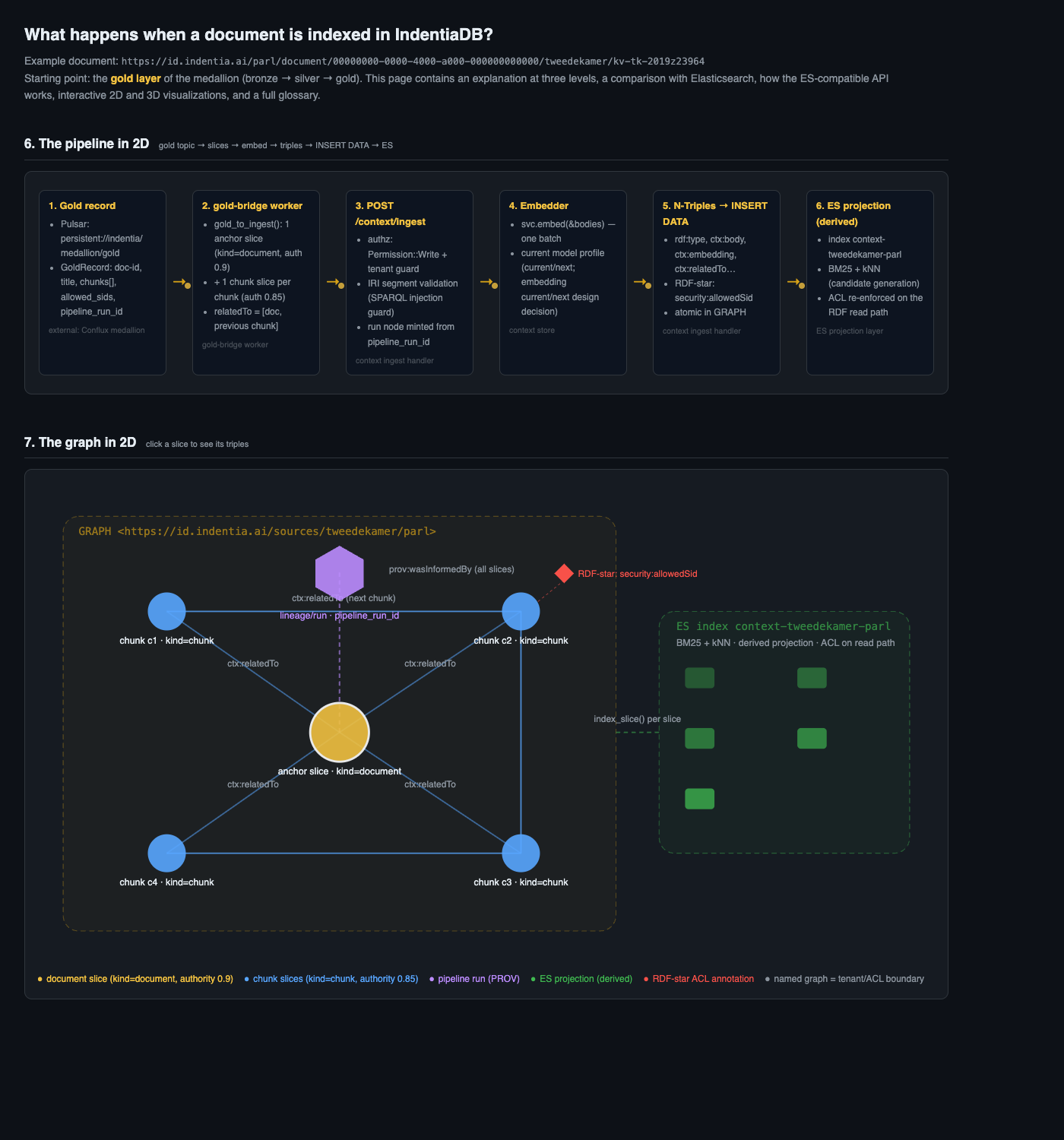
- The pipeline — gold topic → gold-bridge worker (one anchor slice + one chunk slice per chunk, chained via
relatedTo) →/context/ingest→ batch embedding → N-Triples → one atomic SPARQLINSERT DATAinto the named graph → derived Elasticsearch projection. - The graph in 2D and 3D — the document anchor slice, the chunk-slice chain (
ctx:relatedTo), the provenance run node (prov:wasInformedBy), the RDF-star ACL annotation, the vector space (HNSW) and the ES projection — all enclosed by the named graph as the tenant/ACL boundary. - The exact triples per slice, as generated by the ingest handler — click any node in the 2D graph.
- Elasticsearch comparison — indices-with-fields vs. triples-around-a-subject, and how the Elasticsearch-compatible API translates between them (codec, optimistic concurrency, projection).
- A full glossary — every term on the page (medallion, triple, IRI, named graph, RDF-star, bitemporality, BM25, HNSW, RRF, OCC, …) explained inline.
The core idea
Storage is triples in a named graph; cohesion is edges plus provenance; everything else — search indexes, vectors, projections — is a rebuildable derivative. If you drop the search index, you lose nothing: you rebuild it from the graph.
Every slice carries its own evidence and its own lock: provenance (prov:wasInformedBy → the pipeline run → all the way back to the raw bronze file), confidence and authority scores, bitemporal validity, and an RDF-star ACL that sits on the triple itself — see Triple-Level ACL.
Related documentation
- Data Models — how RDF, documents and vectors coexist
- RDF-Star Guide — quoted triples and per-fact annotation
- Data Lineage — provenance and the
pipeline_run_id - Vector Search & RAG — embeddings, HNSW and hybrid retrieval
- Bitemporal Queries — valid time vs. transaction time
- Elasticsearch API — the compatibility layer in detail